The Tree That Can Change the World

Moringa oleifera is a fast-growing tree whose leaves are rich in vitamins, minerals, and protein. It tolerates dry climates and a wide range of soils, and nearly every part of it — leaves, pods, seeds, and flowers — is useful.

We grow live moringa trees, and our first batch of young trees is almost ready to sell. We’re also looking for advocates, farmers, and organizations to partner with, so we can get this remarkable plant growing where it’s needed most.
Get a Tree Join the Mission

The Wonders of Moringa

Moringa leaves are a nutritional powerhouse, rich in vitamins, minerals, and antioxidants.

% Daily Value in 100 g of Fresh Moringa Leaves

Nutrient amounts from USDA FoodData Central (Drumstick leaves, raw); percentages use FDA Daily Values for adults and children 4 years and older.

Environmental Impact

Moringa is a fast-growing tree that tolerates drought and poor soils.

3 m

Possible height after three months

12 m

Possible mature height if left unpruned

pH 4.5–8

Soil range it tolerates

Figures from Leone et al., Int. J. Molecular Sciences, 2015.

Health & Wellness Research

Moringa has been used in traditional medicine for centuries. Researchers are now studying many of these uses — so far, mostly in animal and laboratory studies.

This information is for general education and is not medical advice. Talk to your doctor before using moringa to manage a health condition.

Our Mission

We believe moringa should be growing everywhere it can — especially where people need it most.

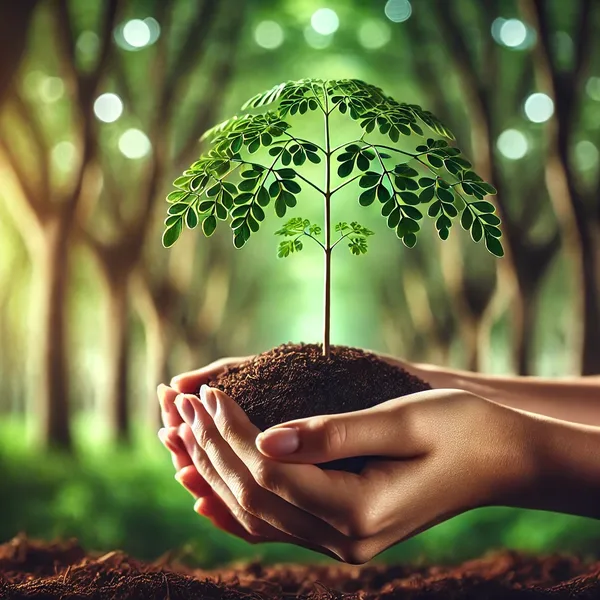
Young moringa seedling held in cupped hands Coming Soon

Live Moringa Trees

We’re preparing to ship live, healthy moringa trees straight to your door. Whether you want one for your backyard or a hundred for a community project, we’ll have you covered. Send us a note and we’ll let you know when trees are available.

Notify Me When Available

Frequently Asked Questions

Moringa oleifera is a fast-growing tree native to the Himalayan foothills of northern India, Pakistan, and Nepal, now grown throughout the tropics. Its leaves, pods, seeds, and flowers are used for food, and its seeds for oil and water clarification. It’s often called the “miracle tree” or “drumstick tree.” Source: Leone et al., Int. J. Molecular Sciences, 2015; NIH LiverTox — Moringa, 2024

Moringa grows best where it stays warm year-round; growth slows noticeably below about 20 °C (68 °F). Frost kills new growth, and established trees survive only brief dips to about 0 °C (32 °F). Where winters get colder, grow it in a container you can bring indoors, or treat it as a summer annual. Source: Radovich, Specialty Crops for Pacific Island Agroforestry (Univ. of Hawai‘i)

Yes. Use a large container with drainage holes and a fast-draining potting mix. Pinch or prune the growing tips regularly to keep the tree compact and bushy — moringa re-sprouts vigorously after cutting. Give it your sunniest, warmest spot. Source: Leone et al., Int. J. Molecular Sciences, 2015; Radovich, Specialty Crops for Pacific Island Agroforestry (Univ. of Hawai‘i)

Plant in full sun and well-drained soil. Moringa handles many soil types, including clay, but not ground that stays soggy. Water regularly while it establishes. Established trees can survive long dry spells, but they produce fewer leaves, so keep watering if you plan to harvest. Source: Radovich, Specialty Crops for Pacific Island Agroforestry (Univ. of Hawai‘i)

Yes — the leaves, young pods, and flowers are eaten as vegetables in many parts of the world. The leaves go into soups, stews, and stir-fries, and young leaves and flowers are often sautéed. One or two backyard trees can usually supply a household. Source: Radovich, Specialty Crops for Pacific Island Agroforestry (Univ. of Hawai‘i)

Moringa is generally well tolerated, and its leaves are widely eaten as food. Because it may lower blood sugar and affect blood pressure, talk to your doctor before eating it regularly or taking it as a supplement if you take medication for diabetes or blood pressure, are pregnant, or have a health condition. Source: NIH LiverTox — Moringa, 2024; Nova et al., Nutrients, 2020 (systematic review); Vergara-Jimenez et al., Antioxidants, 2017

Soon — our first batch of young trees is almost ready. Pricing and shipping areas will be posted when sales open. Send us a note and we’ll let you know as soon as trees are available.

Get in Touch

Want to buy trees, partner with us, or help get moringa growing in your part of the world? We’d love to hear from you.

We only use your details to reply to you. See our Privacy Policy.